
 Laser removal
Laser or remover: which to choose for PMU removal
Both methods work, but in different ways. The choice affects how many sessions you need, how the skin heals and whether you can get a good new PMU afterwards. Here is how we choose the method at a consultation.
At a glance
| Laser | Remover | |
|---|---|---|
| How it works | Breaks up pigment with a pulse of light; the body clears it | A solution binds to the pigment and lifts it out with the scab |
| Best for | Black, grey, blue, dark brown shades | Red, pink, skin-tone, white shades |
| Healing | 1–3 days of redness, sometimes tiny scabs | A scab for 7–10 days |
| Interval between sessions | 4–6 weeks | 6–8 weeks |
| Sessions for brows | 2–4 | 1–3 |
| Edge precision | Good | Very high |
| Procedure time | 10–20 minutes | 20–40 minutes |
How the laser works
We use a PRIME PLUS PRO Nd:YAG Q-switched laser. It fires a very short pulse — 5–7 nanoseconds. In that time the pigment particles absorb the light energy and shatter into smaller pieces. The surrounding skin barely heats up, so with the right settings the risk of a burn is minimal.
The fragmented pigment doesn't disappear at once. Immune cells gradually pick it up and the lymphatic system carries it away. That's why the result is best seen not on the day of the procedure but 4–8 weeks later.
The laser has two wavelengths. 1064 nm goes deeper and is well absorbed by dark colours: black, grey, blue, dark brown. 532 nm works closer to the surface and suits warm shades: red, orange, ginger. We choose the handpiece and settings after a test pulse.
How the remover works
A remover is a special solution that the artist works into the skin with a PMU device, exactly along the pigment line. It binds to the ink particles and draws them out. Over a few days a scab forms on the area, and part of the pigment leaves with it.
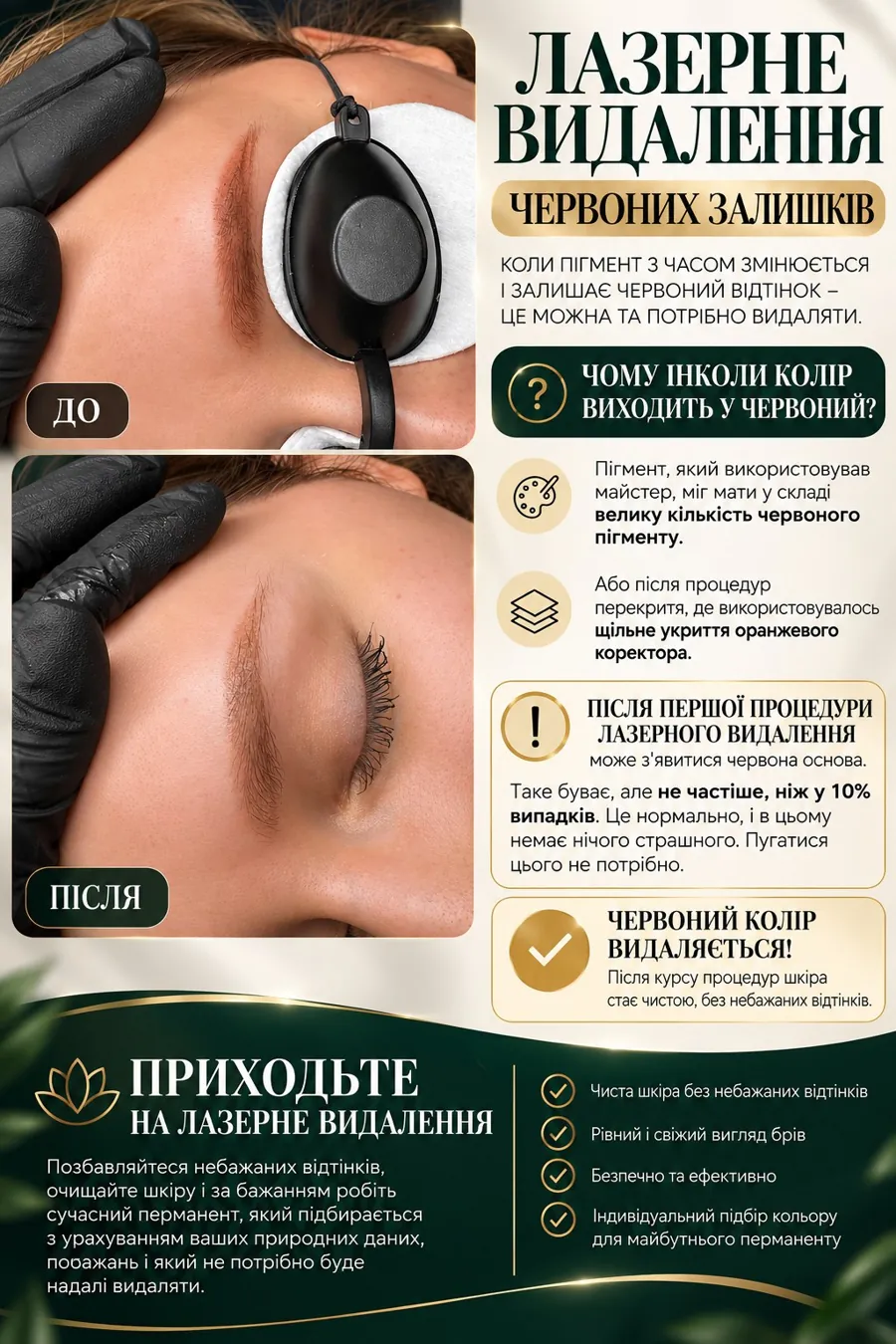
The remover's main advantage is precision. You can remove only a brow tail, an uneven lower edge or a blurred lip outline without touching the rest. And the remover doesn't depend on colour: it works equally well on red, skin-tone and white pigment, which the laser handles less well.
The downside is longer healing. The scab stays for 7–10 days, mustn't get wet in the first days and must never be picked. So the remover asks for more attention to aftercare.
Why red and skin-tone pigments don't like the laser
Many PMU pigments contain iron oxides and titanium dioxide. Under the laser they can change chemically and turn darker. This is called paradoxical darkening. It happens most often with skin-tone, white and some red shades that were once used to "cover" an unsuccessful PMU.
That's why we always start with a test pulse on a small area. If the pigment darkens, we don't use the laser there and switch to the remover. The test is free and takes a few minutes.
When the laser is the obvious choice
- brows have turned grey, blue or greenish over the years;
- lash line and eyeliner — dark pigment on thin eyelid skin;
- the whole area needs even lightening before new PMU;
- the PMU is old, dense or layered;
- tattoo removal on the body — here the laser has practically no alternative.
When the remover is better
- ginger, pink or "orange" brows, a red lip outline;
- only a tail, an edge or a small area needs removing;
- the PMU was previously covered with skin-tone or white pigment;
- the test pulse showed the pigment darkens under the laser.
Combining methods
In complex cases a combination gives the best result. A typical scenario: brows that were brown at first, then turned blue, then were "fixed" with an orange corrector. First the laser lightens the dark blue base, then the remover takes out the warm ginger remnants.
The key rule is to wait in between. The skin must fully recover between laser and remover, usually 6–8 weeks. Rushing doesn't speed things up; it only increases the risk of irritation.
What else affects the choice
- Pigment depth. Deep pigment responds better to the laser, superficial pigment to the remover.
- Your plans. If new PMU is planned, the goal is not just to remove the old one but to prepare an even, light base.
- Skin type. Sensitivity, a tendency to pigmentation and thin skin all shape the method and settings.
- Timing. Before a beach holiday or an important event, choose the method with shorter healing.
How we choose
- Assessment in daylight: colour, density, pigment borders, skin condition.
- History: when the PMU was done, whether there were touch-ups or cover-ups.
- A test pulse on a small area.
- A plan: method, estimated sessions, intervals and what comes after.
We regularly show both methods on Instagram, and prices are on the prices page.
FAQ
Can I have laser and remover on the same day?
No. The skin has to recover from one method before the other is used. Usually there are 6–8 weeks between them.
Which is safer, laser or remover?
Both are safe when chosen correctly. Risks appear when the method is wrong — for example, laser on skin-tone pigment, or remover without proper aftercare.
Does the remover leave scars?
With correct technique and aftercare, no. Scars usually happen when the scab is picked or sessions are done too often.
Can lip PMU be removed by laser?
Yes, if the pigment is dark or brown. For red and pink lip shades we more often choose the remover or the 532 nm wavelength — we decide after a test pulse.
Don't choose a method based on a friend's experience. Brows that look the same can be done with different pigments at different depths. The method is decided at an assessment — send a photo and we'll tell you where to start.